
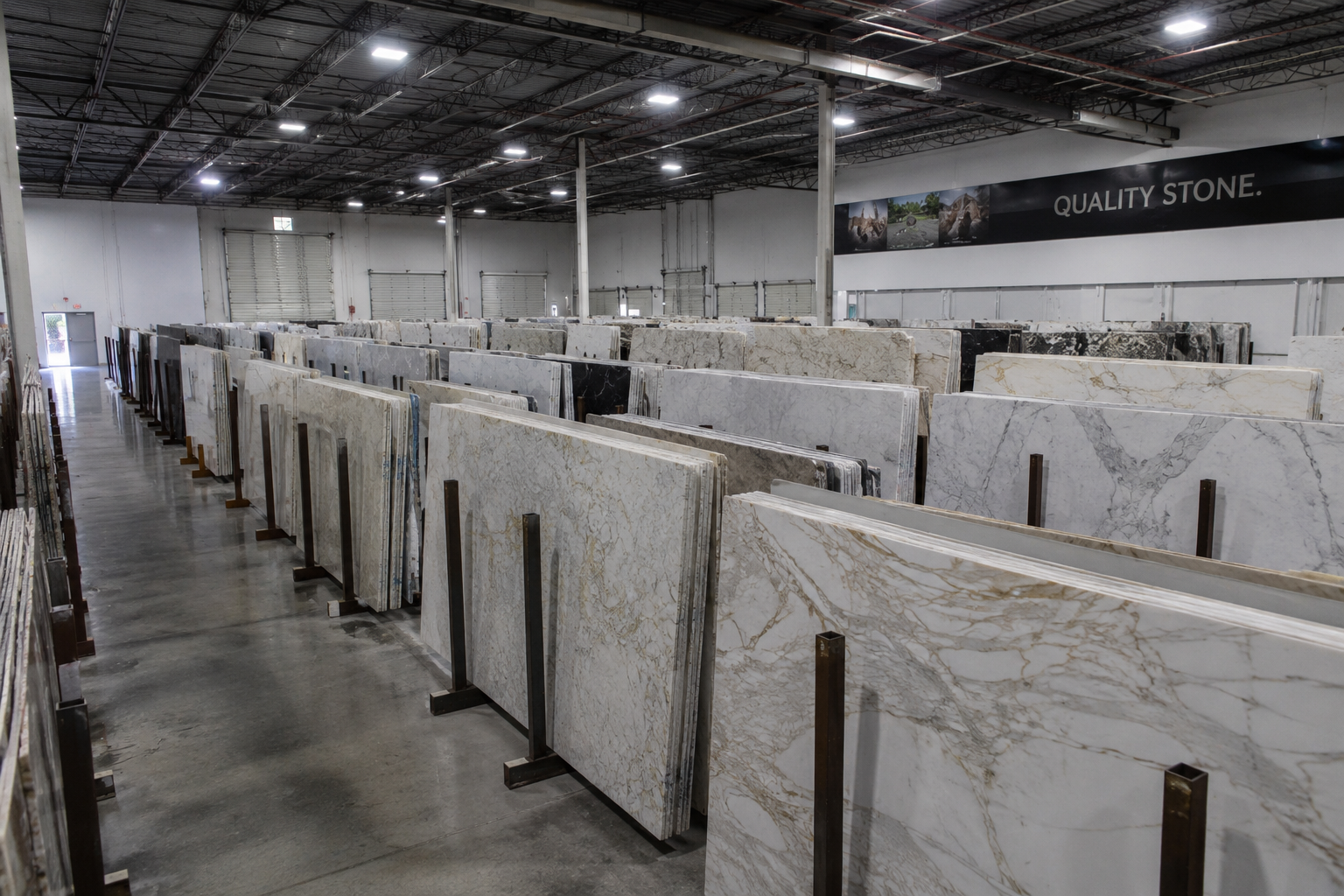
Buying marble is not like buying tile or laminate. You are not picking a product code off a shelf; you are picking one specific slab, cut from one specific block, out of one specific quarry, that will never be repeated again. That makes the company you buy it from just as important as the stone itself.
If you have been searching for marble importers in Indianapolis, you have probably noticed that everyone’s website says roughly the same thing: premium quality, wide selection, competitive pricing. This guide is meant to help you see past that. Below is what actually separates a good importer from an average one, what questions to ask before you put down a deposit, and how to judge whether the price you are being quoted makes sense.
Indiana knows stone. The state is one of the top five dimension stone producers in the country by tonnage, and along with Texas, Wisconsin, Vermont and Georgia it accounts for a large share of everything quarried in the U.S. But what comes out of Indiana ground is limestone, not marble. Indiana limestone is beautiful and historically important, and it sits on buildings all over Washington D.C. but it is not what you want on a kitchen island.
Marble is a different story. Marble makes up only a small sliver of total U.S. dimension stone production, small enough that federal statistics do not even break it out with its own tonnage figure. Net imports accounted for 81% of U.S. dimension stone consumption by value in 2025, and for marble specifically that share is far higher.
So when you look at marble in Indiana, you are almost always looking at stone that came from Italy, Turkey, Greece, Spain, Brazil or India. That is why the word “importer” matters. Anyone can call themselves a supplier. An actual importer is the company handling the sourcing, the container, the customs paperwork and the risk, and that changes what you pay and what you get.
There is real confusion in the market between three types of businesses, and understanding the difference will save you money.
A fabricator cuts and installs stone. Many of them are excellent at what they do, but they buy their slabs from someone else and pass the cost along to you with a markup. A distributor or reseller buys container loads from an importer and resells locally, adding another layer. A true importer brings the stone into the country directly, which means fewer hands between the quarry and your kitchen.
This is why working with marble importers in Indianapolis directly often costs less than going through a fabricator’s supply chain, even when the fabricator is a good one. It also means you can walk in and look at the actual slab you are buying rather than approving a two-inch sample and hoping the full sheet matches.
Not every project needs a direct importer. If you are replacing a small bathroom vanity, convenience may matter more than sourcing. But for kitchen countertops, fireplace surrounds, large floors or anything where the stone is a focal point, the difference shows up in both the price and the final look.
This one is not negotiable. Reputable marble dealers keep full slabs in a warehouse or showroom where you can walk the racks, see the veining across the whole sheet, and tag the specific pieces you want. Marble varies enormously within the same name. Two slabs of Calacatta from two different blocks can look like different stones entirely.
If a supplier only shows you photos, or only has small samples, ask why. Sometimes there is a legitimate answer, like material still in transit. Often it means they are drop-shipping from someone else’s inventory and cannot guarantee what shows up.
A good importer can tell you the quarry region, the block number and roughly when the material landed. That level of detail is a fair test of whether you are talking to an actual importer or a reseller reading off an invoice. It also matters practically; stone from different quarries within the same region can have different density and different behaviour once it is sealed.
Twenty different stones with one slab each is a much weaker inventory than eight stones with matched bundles of four to six slabs. Marble is sold in bundles cut sequentially from the same block, which is how you get book-matched veining across an island and backsplash. If a supplier cannot show you sequential slabs from one bundle, you may end up with mismatched seams in a very visible spot.
This is where marble dealers separate themselves quickly. Membership in the Natural Stone Institute signals that a company is held to published industry standards rather than making up its own. Local building association membership, such as BAGI here in the Indianapolis area, suggests the company works regularly with builders and remodelers who would not tolerate repeated problems. Plutus Marble holds both, and it is a fair thing to ask any supplier about.
A lot of people start with a search for marble wholesale near me, and that is a sensible instinct but the word “wholesale” is used loosely in this industry. Some yards use it to mean genuine trade pricing available only to contractors. Others use it as a marketing term while selling at retail rates.
Here is the practical difference. Genuine wholesale marble pricing usually means you are buying the full slab rather than by the square foot of finished countertop, and that fabrication and installation are billed separately. That can be a very good deal, because you are not paying a markup on labour you have not received yet. It also means you need a fabricator lined up, and you need to be comfortable with the fact that any remnant is yours.
When you search for marble wholesale near me and start calling around, ask directly: is this price per slab or per installed square foot, and does it include fabrication? Two quotes that look 40% apart are often the same number described differently. Ask whether homeowners can buy directly or whether you need to come through a contractor, since policies differ between marble dealers even within the same city.
Bring these to any showroom visit. The answers tell you a lot about how the business runs.
Ask what happens if the slab breaks during fabrication, who absorbs it, and is a replacement from the same bundle available? Ask how long the material has been in the yard, since older inventory sometimes means the bundle has been broken up. Ask what the lead time is if you want something they do not currently stock, because container shipping from Italy or Turkey typically runs several weeks to a few months once the order is placed. Ask what sealing they recommend for your specific stone and how often it needs redoing.
Finally, ask them to talk you out of something. A supplier who will honestly say “marble is a poor choice for that particular application, here is a quartzite that gives you a similar look with more durability” is worth more than one who agrees with everything you say. That kind of candour is a genuine sign of expertise, and it is the difference between a salesperson and a stone specialist.
Indiana gives stone a real workout. Winters are dry with heated indoor air, summers are humid, and the swing between them is significant. Natural stone handles this well, but a few practical points are worth knowing before you choose.
Marble is calcium carbonate, which means it reacts to acid. Lemon juice, vinegar, wine and some cleaning products will etch the surface, leaving a dull mark that is not a stain but a chemical reaction. This is not a defect and it is not the supplier’s fault; it is simply what marble does. Honed finishes hide etching better than polished ones, which is why many Indianapolis kitchens end up with honed marble rather than high polish.
For high-traffic kitchens where you want the marble look with less maintenance, quartzite is often the better answer. Stones like Taj Mahal, Fusion and Cristallo Himalaya give you dramatic veining with considerably more resistance to acid and scratching. Any supplier worth using will walk you through this trade-off honestly rather than selling you the more expensive stone by default.
Also for fireplace surrounds, floors, bathroom vanities and accent walls, marble remains hard to beat. These are lower-contact surfaces where the material’s character shows without the daily abuse of a kitchen counter.
Plutus Marble operates as a direct natural stone importer in Indianapolis, with a showroom at 5150 W 76th St where you can see full slabs in person rather than working from photographs. The inventory covers imported marble alongside quartzite and exotic stones, and the team is available to walk through sourcing, finish options and which material suits your specific room.
The company is a member of both the Natural Stone Institute and the Building & General Industry Association, and works with homeowners, designers and builders across Indianapolis, Carmel, Fishers, Zionsville and the surrounding area. If you would like to talk through a project, you can reach the team at +1 317-734-3862 or rob@plutusmarble.com.
Policies vary between suppliers. Some sell only to the trade, while others work directly with homeowners and will help coordinate with a fabricator. Plutus Marble works with homeowners as well as builders and designers, so you can visit the showroom, select your slab and then have it fabricated by an installer of your choice.
Marble in Indiana generally sits above granite and engineered quartz on price, though the range is wide. Common white marbles are more affordable than rare or heavily veined ones, and the same stone name can vary significantly depending on block quality and vein pattern. The honest answer is that pricing is slab-specific, which is exactly why it is worth visiting a showroom rather than shopping by catalogue
Marble dealers buy stone from importers or distributors and resell it locally. Importers bring the material into the country themselves, handling the sourcing, shipping and customs. Buying from an importer usually means fewer markups and better traceability, since they can tell you exactly which quarry and block your slab came from.
If the slab is already in the Indianapolis warehouse, you can typically take it the same week. If it has to be sourced from overseas, expect several weeks to a few months depending on the quarry, the container schedule and customs clearance. Plan your timeline accordingly, and ask for a realistic date rather than an optimistic one.
It is a reasonable starting point, but treat the word “wholesale” carefully. Some yards use it to mean true trade pricing, others use it as marketing language. When you call, ask whether the quoted price is per slab or per installed square foot, and whether fabrication is included. That single question will tell you more than the website did.

Reflects your commitment to high‑quality marble
and global sourcing.


Copyright © 2026 Plutus Marble. All rights reserved